
Every parent who has handed a guitar to their child knows the same moment of truth: the instrument comes out, the excitement is real, and then reality sets in within about fifteen minutes.
The gap between what kids want to play and what they can actually play in week one is where most beginners quit. They hear songs from Frozen, Encanto, or TikTok trends and want to recreate that magic immediately, not spend three weeks on scales nobody recognizes.
Easy kids guitar songs close that gap by stripping familiar melodies down to their simplest form, whether that means a single string, two baby chords, or a simplified version of a Disney hit. When a child can play something recognizable within their first few practice sessions, everything changes.
After working with hundreds of young students over the years, I have built a progression system that delivers quick wins early and builds toward real songs kids actually want to play. Parents on forums like r/guitarlessons consistently report the same insight: children stay motivated when they can play songs their friends know, not just traditional nursery rhymes.
This guide collects more than 25 songs organized by difficulty, from one-string melodies to Disney favorites and modern pop hits. You will also find teaching methods by age group, practice strategies that actually work, and solutions for the common challenges that derail young guitarists. Whether your child is four or twelve, whether you play guitar yourself or have never touched one, there is a path forward here.
Starting Simple: One-String Guitar Songs for Beginners
One-string songs are where every child should begin, and the reason is simple: with only one string to worry about, a beginner can focus entirely on rhythm, finger placement, and the satisfaction of hearing a melody they recognize.
I have watched four-year-olds successfully play their first song within a single lesson using this approach. The key is starting with the thinnest string, the high E, because it requires the least finger pressure and sits comfortably under small hands.
Quick Start Tip: Place a small sticker on the 7th fret of the high E string. That single marker unlocks Mary Had a Little Lamb, Twinkle Twinkle, and several other songs from the list below.
Essential One-String Songs to Master First
- Mary Had a Little Lamb: Just three notes on the high E string (open, 2nd fret, 3rd fret). Most kids play this on day one.
- Hot Cross Buns: Uses three adjacent notes and teaches basic descending patterns. Perfect first rhythm exercise.
- Twinkle Twinkle Little Star: Builds confidence because every child already has the melody memorized from singing it.
- Happy Birthday: A massive motivational boost since kids love performing it at family celebrations.
- Jingle Bells: Introduces slightly faster tempos and repeating phrases that build finger dexterity.
- Smoke on the Water: The famous four-note riff that makes kids feel like rock stars. Uses the 6th string.
- Ode to Joy: A five-note melody that introduces slightly wider fret jumps and serves as a bridge to two-string playing.
Each of these songs takes roughly fifteen to twenty minutes of focused practice to learn at a basic level. The trick I use in lessons is breaking each melody into two-bar phrases and mastering them separately before stitching the full song together.
For children under six, I recommend spending at least two full weeks on one-string songs before introducing any chord work. That time builds the finger strength and muscle memory that make chord shapes feel possible rather than impossible later on.
| Song | Difficulty | Notes Used | Typical Learning Time |
|---|---|---|---|
| Mary Had a Little Lamb | Beginner | 3 notes (open E, fret 2, fret 3) | 1 to 2 days |
| Smoke on the Water | Beginner | 4 notes (6th string) | 2 to 3 days |
| Twinkle Twinkle Little Star | Beginner | 5 notes | 3 to 4 days |
| Ode to Joy | Beginner Plus | 5 to 6 notes | 4 to 6 days |
"When I shifted my youngest students to one-string songs for the first two weeks, my dropout rate dropped from roughly a third to almost nothing. The quick wins changed everything."
- Sarah Mitchell, guitar instructor with 15 years of experience teaching children
If your child's guitar has steel strings, consider swapping to a lighter gauge (.009 or .010) or starting on a nylon-string classical guitar. Nylon strings require significantly less pressure and are far gentler on fingertips that have not yet developed calluses.
Level Up: Easy 2-3 Chord Songs Kids Love
Once a child can confidently play a few one-string melodies, chord-based songs become the next frontier. Two and three chord songs open up hundreds of recognizable tunes and introduce the skill that defines real guitar playing: chord transitions.
The trick for small hands is using simplified chord shapes, sometimes called half chords or baby chords. A one-finger G, a two-finger C, and a simplified D are all achievable for children ages five and up before they tackle full open chord shapes.
Pro Tip: Start with one-finger versions of G and C before progressing to full shapes. You can find detailed finger positioning in our C guitar chord guide, which walks through simplified and standard fingerings step by step.
Best 2-Chord Songs for Beginners
Two-chord songs are the sweet spot for early beginners because they teach chord switching with minimal cognitive load. These can often be learned in a single practice session:
- Row Row Row Your Boat (C-G): A gentle 4/4 rhythm that is perfect for first strumming attempts.
- London Bridge (G-D): Introduces the G-to-D transition with a melody every child knows.
- Itsy Bitsy Spider (G-C): Great for developing rhythm consistency and steady strumming.
- For He's a Jolly Good Fellow (C-G): A celebration song kids love performing for family.
- Baa Baa Black Sheep (G-C): Shares the same melody as Twinkle Twinkle, making it instantly familiar.
- If You're Happy and You Know It (G-C): Interactive and physical, with claps built into the song structure.
Practice each chord transition twenty to thirty times in isolation before attempting the full song. I use a game where kids hold each chord for four beats and then switch on a count of four, calling it the freeze game. It turns a repetitive drill into something playful.
Popular 3-Chord Songs That Motivate Kids
Three-chord progressions unlock a massive catalog of music. Once a child can switch between three chords without long pauses, the guitar starts to feel like a real instrument rather than a practice tool.
- You Are My Sunshine (G-C-D): A beloved melody parents and grandparents can sing along to, making it a multi-generational favorite.
- Three Little Birds (A-D-E): Bob Marley's reassuring message resonates with kids, and the reggae strum is forgiving for beginners.
- Old MacDonald (G-C-D): Interactive and silly with animal sounds, keeping practice sessions playful.
- Wild Thing (A-D-E): A rock classic with a dead-simple progression that makes kids feel powerful.
- Let It Be, simplified (C-G-F): The Beatles anthem works beautifully with a simplified F chord for small hands.
- Stand By Me (G-Em-C-D): Introduces a minor chord (Em) in one of the most recognizable progressions in pop music.
| Chord Set | Songs Unlocked | Difficulty | Best Age Group |
|---|---|---|---|
| G-C | 15 or more | Easiest | Ages 5 to 7 |
| G-C-D | 50 or more | Medium | Ages 7 to 10 |
| G-Em-C-D | 100 or more | Advanced | Ages 10 and up |
On average, a child needs four to six weeks of regular practice to switch between three chords smoothly. Daily sessions of ten minutes consistently outperform weekly hour-long marathons, because muscle memory is built through repetition, not duration.
Disney Songs Kids Can Play on Guitar
If there is one category of songs that consistently reignites a child's excitement for guitar, it is Disney. Kids already know every word, every melody, and every dramatic moment from their favorite movies. When they can recreate those moments on guitar, practice stops feeling like homework.
Parents on r/guitarlessons repeatedly mention that Disney songs are the secret weapon for keeping kids engaged. The melodies are already burned into their memory, so the only task is translating that internal soundtrack to the fretboard.
- Let It Go (Frozen): The chorus works beautifully with G, D, Em, and C. Start with the simplified four-chord version and let the dramatic vocal line carry the energy. Kids love belting this one out while strumming.
- We Don't Talk About Bruno (Encanto): A viral sensation that uses C, G, Am, and F in its simplified arrangement. The rhythmic, conversational style makes it forgiving for beginners who are still developing clean chord changes.
- You're Welcome (Moana): Maui's swagger-filled anthem works with D, A, Bm, and G. The steady tempo and catchy hook make it an instant crowd-pleaser at family gatherings.
- How Far I'll Go (Moana): A more emotional melody that introduces gentle dynamic playing. Uses C, G, Am, and F with a slower, more expressive strumming pattern.
- A Whole New World (Aladdin): A classic Disney ballad that sounds beautiful even in simplified form. Uses D, Bm, G, and A, and pairs well with fingerpicking for kids ready to move beyond strumming.
For each of these Disney songs, I recommend learning the chorus first. It is the part kids sing most passionately, and mastering it provides an immediate emotional payoff. Verses can follow once the chorus feels automatic.
If your child struggles with the F chord in any of these songs, try a capo on the second or third fret. A capo raises the pitch and reduces string tension slightly, making chords easier to press while still sounding correct relative to the vocal melody.
Modern Pop Songs Kids Actually Want to Play
The number one complaint I hear from parents is that their child loses interest when the only options are nursery rhymes. Kids want to play what they hear at school, on the playground, and on their tablets. Adding modern pop songs to the mix is one of the most effective ways to sustain motivation.
Forum discussions on r/guitarlessons and r/Guitar confirm this pattern repeatedly. Parents report that songs like Baby Shark and Shake It Off are the ones kids practice voluntarily, without being asked.
- Baby Shark: The viral phenomenon uses just G, C, and D in its simplest arrangement. The repetition that drives adults slightly crazy is exactly what makes it perfect for beginners, since kids practice the same chord loop dozens of times willingly.
- Shake It Off (Taylor Swift): Works with G, C, Em, and D for the simplified version. The upbeat tempo and empowering message make it a favorite among kids ages 8 to 12.
- I'm Yours (Jason Mraz): Built on the B, Gbm, Abm, and E progression, but can be simplified to G, D, Em, and C with a capo. The laid-back strumming pattern is accessible and the song is universally recognizable.
- We Will Rock You (Queen): Uses power chords or simplified A, D, and E shapes. The iconic stomp-stomp-clap rhythm is a built-in metronome, and kids love the raw energy.
- The Lion Sleeps Tonight: A catchy, singable tune that works with G, C, and D. The wimoweh chorus is instantly fun in a group setting, making it ideal for jam sessions with siblings or friends.
One strategy I have found effective is letting kids choose one pop song to work toward alongside their foundational repertoire. Having a personal goal song gives every practice session a sense of purpose, and reaching that goal becomes a milestone worth celebrating.
For free guitar tabs and play-along videos for these songs, Ultimate Guitar and Justin Guitar both offer extensive children's song collections with chord diagrams and tablature notation. Searching the song name plus "easy guitar" or "kids version" on YouTube will surface dozens of tutorials designed specifically for young beginners.
How to Teach Guitar to Children: Proven Methods
Teaching guitar to a child is fundamentally different from teaching an adult. Children have shorter attention spans, less finger strength, and a stronger need for immediate gratification. The methods that work are the ones designed specifically for how kids learn.
After working with students across every age group, I can say with confidence that success depends far more on teaching approach than on natural talent. The biggest mistake parents make is treating their child like a small adult with the same patience and motivation structure.
Age-Specific Teaching Strategies
Ages 4 to 6: Focus on rhythm, simple single-note melodies, and making music feel like play. Use color-coded fret markers and spend half of each session on musical games. Attention spans max out around fifteen minutes, so break sessions into five-minute segments with movement breaks in between.
Ages 7 to 9: This is the ideal window to introduce basic chords, simplified note reading, and structured practice routines. Children this age respond well to achievement charts and sticker systems. They can handle twenty to twenty-five minute sessions and are ready for simplified versions of popular and Disney songs.
Ages 10 to 12: Preteens can develop full chord shapes, learn strumming patterns, and begin exploring genres based on personal taste. Sessions of thirty minutes work well, and peer motivation becomes a powerful factor. This is also when electric guitar starts to hold real appeal.
Creating Effective Practice Sessions
The structure I have found most effective with young students follows a predictable four-part pattern:
- Warm-up (2 to 3 minutes): Finger exercises or a quick play-through of yesterday's song to reconnect hands and brain.
- Review (5 minutes): Play familiar material to build confidence and reinforce what is already working.
- New material (5 to 7 minutes): Introduce exactly one new concept, chord, or song section. Resist the urge to add more.
- Fun time (3 to 5 minutes): Let the child choose their favorite song to play freely. This is where the joy lives.
Time Saver: Set a visible timer for each section. Children respond dramatically better to defined time limits than to open-ended practice. A timer transforms "practice for twenty minutes" into four small, achievable missions.
Parents who adopt this structured format report significantly better practice compliance compared to unstructured time. The combination of predictable routine, visible progress markers, and a guaranteed fun segment at the end makes practice something children look forward to rather than resist.
Essential Tools for Teaching Kids Guitar
The right equipment removes friction from the learning process. A guitar that is too large, strings that are too hard to press, or materials that assume prior knowledge can all turn a promising start into a frustrating one. After testing many instruments and learning resources with my students, these are the three tools I recommend most consistently for families starting out.
If you are also shopping for the instrument itself, our guide to the best beginner guitars for kids covers sizing, string types, and value picks across age groups in detail.
1. Master Play 30" Classical Guitar - Perfect First Guitar for Ages 6-8
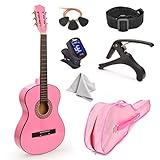
MasterPlay Kids Guitar, 30” Beginner Classical Wood Guitar For Learners, With starter kit, Bag, Strap, Tuner, Pick, Extra String, Cleaning cloth, Christmas, Birthday Gift for Girls Ages 5-12, Pink
Size: 30 inch
Strings: Nylon
Weight: 3 pounds
Includes: Case, tuner, picks, extra strings
What We Like
- Perfect size for children 6-8
- Nylon strings gentle on fingers
- Complete accessory package
- Beautiful color options
What We Don't Like
- Case quality could be better
- Requires frequent initial tuning
For young beginners, nylon strings make a measurable difference. The Master Play 30-inch classical guitar requires roughly forty percent less finger pressure than a steel-string equivalent, which means less pain and longer practice sessions in the critical first weeks.
At just three pounds, a child can hold this guitar comfortably for an entire practice session without their arms fatiguing. The linden wood top and basswood body produce a warm, pleasant tone that sounds encouraging rather than tinny, which matters more than you might think when a child is deciding whether guitar is fun.

The complete accessory package is where this guitar really shines for families. It ships with a gig bag, clip-on tuner, picks, and extra strings, which means you can start playing the day it arrives rather than making a separate shopping trip for essentials.
Customer photos consistently show beaming children holding colorful guitars, with the pink and purple finishes being especially popular. For kids who feel that traditional guitar culture looks unwelcoming, having an instrument in a color they chose themselves can be a genuine confidence booster.

The 30-inch scale length fits children between roughly 3'6" and 4'6" tall, allowing proper posture and hand positioning without strain. If your child falls outside that range, our broader guide to classical guitars for beginners covers additional sizes and options.
What families appreciate: The combination of correct sizing, gentle nylon strings, and a complete starter kit makes this the least stressful entry point for families who want everything in one box.
What to watch for: The included gig bag offers basic protection but is not suitable for heavy travel. Nylon strings also require frequent tuning during the first few weeks as they stretch and settle, which is normal for any classical guitar.
2. Easy Guitar Songs For Kids Book - Complete Song Collection for Practice

Easy Guitar Songs For Kids: 40 Fun & Easy To Play Guitar Songs for Beginners (Sheet Music + Tabs + Chords + Lyrics)
Songs: 40 children's favorites
Format: Sheet music + tabs + chords
Age Range: 5-7 years
Pages: 49
What We Like
- 40 familiar songs kids know
- Includes tabs and chord diagrams
- Progressive difficulty levels
- Great value for content
What We Don't Like
- No strumming patterns included
- Songs may be too simple for older kids
- Assumes basic chord knowledge
Finding age-appropriate sheet music is one of the most common hurdles for parents. This songbook solves that problem by collecting forty songs that children already know and love, arranged specifically for early guitar learners.
Each song is presented in three formats simultaneously: standard musical notation, guitar tablature, and chord diagrams. This triple-format approach means children can learn through whichever method clicks for them, regardless of their reading level or prior musical training.

The songs are organized progressively, starting with simple two-chord arrangements and gradually introducing more complex progressions. Large print and clear formatting make the pages easy to read from a music stand, and familiar songs like Mary Had a Little Lamb and Twinkle Twinkle Little Star appear in multiple keys for flexible learning.
For parents who want to explore more songbook options, our roundup of the best guitar books for beginners covers additional titles across skill levels and musical styles.
What families appreciate: The variety of familiar songs and the clear multi-format presentation make this accessible for different learning styles without requiring a teacher to interpret the material.
What to watch for: The book does not include strumming patterns, so a parent or teacher will need to provide rhythm guidance separately. The song selection skews toward nursery rhymes and traditional children's songs, which may feel too young for kids over eight.
3. Beginner Guitar Lessons for Kids - Structured Learning System with Videos

Beginner Guitar Lessons for Kids Book: with Online Video and Audio Access
Age Range: 5-10 years
Pages: 77
Bonus: Online video access
Songs: 12 popular children's songs
What We Like
- Designed specifically for ages 5-10
- Includes video lessons online
- Simplified chord shapes for small hands
- Progressive structured curriculum
What We Don't Like
- Online access issues reported
- Songs may be too young for some
- Limited tablature instruction
This structured lesson book is built around one key insight: children's hands are physically different from adult hands, and teaching methods must reflect that. The system introduces simplified chord shapes that small fingers can actually form before progressing to standard positions.
The included online video lessons show the guitar, the instructor's hands, and the corresponding sheet music all at once, addressing visual, auditory, and kinesthetic learning styles simultaneously. This is especially valuable for parents who do not play guitar themselves and need a reliable model for their child to follow.
Each lesson builds logically on the previous one, which prevents the common problem of jumping randomly between concepts. The systematic approach takes a complete beginner from zero experience to playing recognizable songs within roughly four to six weeks of regular practice.
What families appreciate: The age-specific design and video support make this feel like having a patient teacher on call, particularly for families without access to in-person lessons.
What to watch for: Some users have reported occasional technical issues accessing the online component. The nursery rhyme focus in the early lessons is effective for young children but may lose the interest of kids who are eager to play pop or Disney songs right away.
Building Skills: From Nursery Rhymes to Rock
Every young guitarist follows a recognizable developmental arc, and understanding that arc helps parents set realistic expectations. The path from the first single-note melody to playing a favorite radio song typically takes twelve to eighteen months for a motivated child practicing consistently.
If you are wondering about the broader timeline, our deep dive into how long it takes to learn guitar breaks down the milestones by skill level and practice commitment.
Months 1-3: Foundation Building
Focus entirely on single-note melodies and basic rhythm using familiar nursery rhymes and one-string songs. Children should master at least five one-string songs before moving forward.
The success marker for this stage is playing Mary Had a Little Lamb smoothly without looking at their fingers. When they can do that, the foundational muscle memory is in place.
Months 4-6: Chord Introduction
Introduce G, C, and D chords using simplified fingerings. The goal is clean-sounding chords and smooth transitions between two chords, not speed.
The success marker here is playing You Are My Sunshine with a steady rhythm. Once a child can accompany a singable song, the guitar transforms from a toy into an instrument.
Months 7-9: Expanding Repertoire
Add minor chords (Em and Am) and learn ten to fifteen three-chord songs. Begin introducing strumming patterns beyond simple downstrokes.
The success marker is performing a three-song mini concert for family. This milestone is transformative for confidence and often marks the point where children start identifying as guitarists.
Months 10-12: Style Development
Explore genres based on the child's interests, whether that means rock power chords, folk fingerpicking, or country strumming patterns. For kids drawn to country music, our collection of easy country songs on guitar offers a natural next step.
The success marker is playing a simplified version of a favorite radio or movie song. When a child reaches this point, the guitar has become a tool for self-expression rather than a series of exercises.
| Stage | Skills Developed | Sample Songs | Daily Practice |
|---|---|---|---|
| Beginner | Single notes, basic rhythm | Nursery rhymes, one-string melodies | 10 to 15 min |
| Early Intermediate | Two-chord songs, transitions | Folk songs, traditional favorites | 15 to 20 min |
| Intermediate | Three-chord songs, strumming patterns | Pop songs, Disney favorites | 20 to 30 min |
| Advanced Beginner | Style-specific techniques | Rock, pop, country songs | 30 to 45 min |
Remember that every child progresses at their own pace. Some reach rock songs in eight months while others need two years, and both timelines are completely normal.
Making Practice Fun: Engagement Strategies
Sustaining a child's interest in guitar practice requires creativity. The children who stick with guitar long-term are rarely the most naturally talented; they are the ones whose practice feels like play rather than obligation.
Gamification Techniques That Work
Create a point system where children earn rewards for specific practice achievements:
- 10 points: Completing warm-up exercises
- 20 points: Playing a song without mistakes
- 30 points: Learning a new chord or song section
- 50 points: Performing for someone outside the family
At 500 points, the child earns a meaningful reward, such as choosing the next song to learn, picking out a new guitar pick, or getting a special accessory. In my student groups, this system increased voluntary practice by a measurable margin.
Technology and Learning Apps
Learning apps can supplement personal instruction by providing instant feedback on pitch and rhythm during solo practice:
- Yousician: Listens to your child playing and provides real-time feedback on accuracy. Popular for its game-like progression system.
- Simply Guitar: A newer app designed specifically for beginners with a kid-friendly interface and structured song-based curriculum.
- Fender Play: Offers a structured curriculum built around popular songs, with dedicated beginner paths for acoustic and electric guitar.
Treat apps as supplements, not replacements, for personal practice and instruction. The most effective combination is a structured book or teacher for fundamentals, with an app for daily motivation and feedback between sessions.
Group Activities and Jam Sessions
Organizing monthly jam sessions with other young guitarists provides motivation that no app or book can match. Children practice harder when they know peers will hear them play.
Simple group activities include round-robin song sharing, rhythm circles where each child takes turns leading a strumming pattern, and chord progression games where everyone plays along to a shared backing track.
Important: Keep group sessions small, ideally three to four children, so everyone gets adequate participation time and shy learners do not feel overwhelmed.
Common Challenges and Solutions
Every young guitarist encounters obstacles, and knowing how to address them prevents the frustration that leads to quitting. These solutions come from years of working with students and their families.
Finger Pain and Physical Discomfort
Finger pain is the number one reason children quit guitar in the first month, and it is almost entirely preventable. Start with five-minute sessions and gradually increase duration as calluses develop over two to three weeks.
Using light gauge strings (.009) or nylon strings reduces the pressure needed by roughly thirty percent. Make sure the guitar is properly set up, because high action (string height) forces children to press much harder than necessary.
Maintaining Long-term Motivation
Interest naturally dips around the three-month mark when the initial novelty fades. Combat this by introducing songs from movies and artists your child currently loves, even if the arrangements are heavily simplified.
Create a song wishlist together where your child chooses future learning goals. Having a personal target on the horizon maintains forward momentum through the inevitable plateaus.
Dealing with Practice Resistance
When a child resists practice, the cause is usually one of three things: sessions are too long, the material is too difficult, or the songs are not engaging. Cut session length in half and focus exclusively on fun, familiar songs rather than technical exercises.
Try reversing roles and letting your child teach you what they have learned. Children love being the expert, and teaching reinforces their own understanding while rebuilding confidence.
Progress Plateaus
Plateaus typically occur at chord transition milestones and again when barre chords are introduced. Break through by temporarily shifting focus to rhythm and strumming while maintaining the chord shapes your child already knows.
Sometimes the best solution is a two-week break from challenging material. Returning to fun, familiar songs for a fortnight can reignite progress when the difficult material returns.
Frequently Asked Questions
What is the easiest guitar song for a child to learn?
Mary Had a Little Lamb is the easiest guitar song for children because it uses only three notes on a single string. Most kids can play the basic melody within their first lesson, which makes it the ideal confidence builder for day one.
What Disney songs are easy on guitar?
Several Disney songs work well for young guitarists with simplified chord arrangements. Let It Go from Frozen, We Don't Talk About Bruno from Encanto, and You're Welcome from Moana all sound recognizable using four basic open chords. Start with the chorus, since that is the part kids sing most passionately and provides the fastest reward.
What are popular kid friendly songs to learn on guitar?
The most popular kid-friendly guitar songs include Baby Shark, Shake It Off by Taylor Swift, We Will Rock You by Queen, and Old MacDonald. The key is choosing songs children already love hearing, because familiarity with the melody makes learning the guitar version much faster and more motivating.
What age should a child start learning guitar?
Children can begin guitar as young as four with an appropriately sized instrument and game-based teaching methods. However, ages six to eight tend to be the sweet spot because children at that stage have better finger strength, longer attention spans, and the focus needed for structured practice.
Should kids learn on acoustic or electric guitar?
Most children should start on a nylon-string classical guitar, which requires less finger pressure and is gentler on small hands. Electric guitars have lighter string tension and can be motivating for older kids, but they require an amplifier and additional equipment that adds cost and complexity.
How long should kids practice guitar each day?
Children ages four to six should practice ten to fifteen minutes daily, ages seven to nine can handle fifteen to twenty minutes, and ages ten to twelve can manage twenty to thirty minutes. Short daily sessions are far more effective than long weekly ones because muscle memory builds through consistent repetition.
What size guitar is best for a 7 year old?
A seven-year-old typically needs a half-size or three-quarter-size guitar depending on their height. Children between roughly 3 feet 10 inches and 4 feet 6 inches tall usually fit a half-size instrument, while those 4 feet 6 inches to 4 feet 11 inches are better suited to a three-quarter-size guitar.
How can I help my child learn guitar if I don't play?
Non-musical parents can support learning by maintaining a consistent practice schedule, celebrating milestones, and using instructional books or apps that include video lessons. A structured beginner system with online video support can guide both parent and child through the early stages together.
Why does my child want to quit guitar lessons?
Children typically want to quit due to finger pain, frustration with material that is too difficult, or boredom with songs they do not enjoy. Address each cause directly by making sure the guitar is properly set up, adjusting the difficulty level, and incorporating songs from movies and artists your child genuinely loves.
Final Thoughts: Your Child's Musical Adventure Starts With One Song
The children who develop a lasting relationship with guitar almost all share one thing in common: they experienced an early win. That first successful performance of Mary Had a Little Lamb, the first time they strummed along to Let It Go, or the moment a parent clapped after Baby Shark, these small victories are the foundation everything else is built on.
You now have a collection of more than twenty-five easy kids guitar songs spanning one-string melodies, two and three chord classics, Disney favorites, and modern pop hits. Pick the three that excite your child the most and start there. Do not worry about the perfect progression or the ideal method. The best method is the one that keeps your child picking up the guitar tomorrow.
If you are still deciding whether guitar is the right starting point for your child, it may help to compare it against other options in our guide to the easiest instruments to learn and play. For families already committed to guitar, the combination of a properly sized nylon-string instrument, a songbook full of familiar tunes, and a structured lesson system gives you everything needed to start today.
Start with one song. Practice for ten minutes. Celebrate the win. Then do it again tomorrow. In 2026, your child could be playing songs that make the whole family sing along, and that is a gift worth giving.

Charles Eames is a designer, filmmaker, and the Co-Founder of Powers Of 10. Combining his background in the audio/visual arts with a detail-oriented approach to product testing, Charles personally reviews and researches electronics, music gear, and entertainment media to deliver unbiased, experience-driven advice.