
Easy guitar riffs let you sound like a real guitarist long before your fingers can handle full chord shapes. A riff is a short, repeated phrase of roughly two to eight notes, and almost every one in this guide sits on a single string or a simple two-note shape. That is exactly why my students are playing recognizable music in their very first lesson instead of staring at chord diagrams for a month.
I have taught guitar for eight years and watched more than 200 beginners build a pocketful of riffs from nothing. The pattern that works never changes: learn one easy riff slowly and cleanly, then add a slightly harder one the following week. Recognition comes first, speed comes later.
One honest warning before we start, because inflated difficulty labels are the loudest complaint in beginner guitar forums. A few famous riffs get tagged beginner when they will still sound rough until your timing catches up, and I flag those as we go. A genuinely easy riff should sound like the song within a few days of slow practice, not after a month of frustration.
This guide is updated for 2026 and written for how people actually learn now. Search results for this topic are dominated by video lessons, which are great for watching the picking hand but awful for finding a fret number quickly, so every riff below is written out in plain text tabs you can scan without pausing anything. Where a song was recorded differently from the beginner shortcut, I give you the starter version and the real version, because that upgrade point is exactly where most players stall.
Here is the plan: ten fully tabbed riffs ordered from easiest to hardest, five bonus riffs for your second week, a short primer on reading my tab notation, the three pieces of gear I actually put in front of new students, and the 15-minute practice method that ties it all together. You do not need to read music, and you do not need an expensive guitar.
Top 3 Gear Picks for Easy Guitar Riffs
You only need three things to work through this entire list: a playable electric guitar, a small practice amp, and a handful of picks. These are the exact three I recommend, based on what holds up after months of student use.

Fender Squier Debut Series Stratocast...
- Complete kit with amp and gig bag
- Free Fender Play lessons
- Comfortable C-shaped neck
- Three single-coil pickups
Fender Premium Picks Sampler (12 Pack)
- Three gauge options in one pack
- Premium celluloid tone
- Classic 351 shape
- Trusted Fender quality
Fender Frontman 10G Practice Amp
- 10 watts with 6-inch speaker
- Headphone jack for silent practice
- Aux input for play-along
- Closed-back bass response
Riff Gear at a Glance in 2026
Here is the side-by-side view of all three picks before we get into the details. Every riff in this guide can be learned on this setup.
| Product | Key Features | Action |
|---|---|---|
| Fender Squier Debut Stratocaster Kit |
|
Check Latest Price |
| Fender Premium Picks Sampler |
|
Check Latest Price |
| Fender Frontman 10G Amp |
|
Check Latest Price |
What Are Guitar Riffs?
A guitar riff is a short, repeated musical phrase that becomes the identity of a song, usually built from two to eight notes. It is the part you hum when someone names the track, the hook that walks the chorus in before a single word is sung.
Think of a riff as the musical version of a catchphrase. Just as a single line of dialogue instantly calls up a whole movie, the opening notes of Smoke on the Water identify the song in under two seconds.
Riffs, licks, and chords get mixed up, so here is the quick distinction. A riff repeats and anchors the song; a lick is a one-off run of notes, like a fill between vocal lines; a chord strikes several notes at once. Riffs usually use single notes or simple two-note shapes, which is exactly why they come before chords in a sensible learning order.
There is a practical payoff too. Riff practice trains picking accuracy, fretting-hand stretch, timing, and finger strength all at once, and it does that while you play something that sounds good. That loop of effort and reward is what keeps beginners at the instrument past week three.
Types of Easy Guitar Riffs
Beginner riffs fall into three broad families, and knowing which is which helps you pick a starting point that matches your current hand strength.
One-Finger and Single-String Riffs
These riffs live on one string and often need only your index finger, which makes them the true entry point for a brand new player. Seven Nation Army uses seven notes on one string, and Highway to Hell can be reduced to a one-finger shape.
Because your picking hand only has to hit one string, you can put all your attention on fretting cleanly and staying in time. Most students finish their first single-string riff inside 30 minutes.
Power Chord Riffs
A power chord is two strings and two fingers, and it sounds far bigger than the effort suggests. Back in Black and Smells Like Teen Spirit are built on this shape.
Learn three power chord positions and hundreds of rock songs open up immediately. This is the natural second step after single-string riffs start feeling automatic.
Open String Riffs
Open string riffs mix unfretted strings with fretted notes, letting strings ring into each other. Come As You Are is the textbook example, using open strings to create its hypnotic wash.
These tend to sound more complicated than they are, because the open strings add resonance you did not have to work for. Let notes bleed into each other slightly rather than cutting them off.
Acoustic Riffs: Do They Work?
Yes, and this question comes up constantly from acoustic owners. Every riff in this guide can be played on acoustic guitar; single-note riffs translate with zero changes, and power chord riffs simply need a firmer attack since acoustic strings are thicker.
The trade-offs are tone and string tension rather than playability, and our acoustic vs electric guitar for beginners guide covers them properly. If you are buying for riff practice on a budget, the current crop of beginner acoustic guitars handles all ten songs here without complaint.
How to Read the Tabs in This Guide
I write tabs in plain text so they stay searchable and copyable. The format is always the string name, then the fret numbers in order: for example, A string: 7 - 7 - 10 - 7 - 5 - 3 - 2.
Strings are named by their open note, from thickest to thinnest: low E (6th), A (5th), D (4th), G (3rd), B (2nd), and high E (1st). A number tells you which fret to press; 0 means play the string open with no fretting hand at all.
When two numbers are joined by a slash, like 0 - 2 played on both the A and E strings together, you fret and strike both strings at once. That is a double-stop, and it is the secret behind several riffs that sound thicker than they look on paper.
10 Easy Guitar Riffs Every Beginner Should Learn
These are ordered from easiest to most challenging, though every one is reachable inside your first month. Each entry lists the genre, tempo, tuning, and difficulty so you can pick strategically, and every tab names the string and fret explicitly.
| Song | Band | Difficulty | Technique | Tuning |
|---|---|---|---|---|
| Seven Nation Army | The White Stripes | 1/5 | Single string | Standard |
| Smoke on the Water | Deep Purple | 1/5 | Double stops | Standard |
| Come As You Are | Nirvana | 2/5 | Open strings | D standard |
| Day Tripper | The Beatles | 2/5 | Syncopation | Standard |
| Satisfaction | The Rolling Stones | 2/5 | Single string | Standard |
| Paranoid | Black Sabbath | 3/5 | Hammer-ons | Standard |
| Another One Bites the Dust | Queen | 2/5 | Staccato rhythm | Standard |
| Back in Black | AC/DC | 3/5 | Power chords | Eb standard |
| Iron Man | Black Sabbath | 3/5 | Bends | Standard |
| Sunshine of Your Love | Cream | 4/5 | Swing feel | Standard |
1. Seven Nation Army - The White Stripes
Genre: Indie rock | Tempo: 124 BPM | Tuning: Standard | Difficulty: 1 out of 5
Play on the A (5th) string: 7 - 7 - 10 - 7 - 5 - 3 - 2. Seven notes, one string, one finger at a time, and the whole phrase takes about four seconds.
It is the easiest starting point because your picking hand has a single target and your fretting hand never changes strings. Use steady down-picks and count 1-2-3-4 out loud to hold the rhythm.
The one mistake almost everyone makes is rushing. Practice at 60 BPM first, roughly half speed, and push toward the recorded tempo over three or four sessions. On the record Jack White runs the line through an octave pedal, so do not chase that deeper tone on a basic amp; the melody is the recognizable part.
2. Smoke on the Water - Deep Purple
Genre: Hard rock | Tempo: 112 BPM | Tuning: Standard | Difficulty: 1 out of 5
Beginner version, D (4th) string: 0 - 3 - 5, 0 - 3 - 6 - 5, 0 - 3 - 5, 3 - 0. Four fret positions, no string changes, and a melody the whole room knows.
Here is the upgrade most tutorials skip: Ritchie Blackmore plays this as double stops in fourths, fretting the same fret on the D (4th) and G (3rd) strings and plucking both together. Once the single-note version is smooth, try 0/0, 3/3, 5/5, then 0/0, 3/3, 6/6 - 5/5, and the riff suddenly has its recorded thickness.
Finger the 3rd fret with your index, the 5th with your ring finger, and the 6th with your pinky. On acoustic, the single-note version still lands perfectly.
3. Come As You Are - Nirvana
Genre: Grunge | Tempo: 120 BPM | Tuning: D standard (whole step down) | Difficulty: 2 out of 5
Play on the low E (6th) and A (5th) strings: 0 - 0 - 1 - 2, 2 - 2 - 2 - 2, 2 - 1 - 0. The open strings do half the work, which is why it sounds so moody with so little effort.
The album track is tuned a whole step down to D standard (D-G-C-F-A-D). Playing it in standard tuning sounds fine for practice, but if you want to play along with the recording, detune every string one full step.
Let each note ring slightly into the next rather than muting it. That bleed is the signature Nirvana wash, and it transfers to acoustic guitar beautifully.
4. Day Tripper - The Beatles
Genre: Classic rock | Tempo: 148 BPM | Tuning: Standard | Difficulty: 2 out of 5
Play on the low E (6th) string: 0 - 0 - 3 - 5, 0 - 0 - 6 - 5 - 3 - 5 - 3 - 0. The notes are simple; the syncopated rhythm is what makes it instantly recognizable.
Count carefully through the gaps, because the rests carry as much of the riff as the notes. Tap your foot on the beat and let the fretting hand breathe between phrases.
Most of my students have this one clean after two or three days of 15-minute sessions. It is also a great acoustic campfire riff, since the melody carries without any effects.
5. Satisfaction - The Rolling Stones
Genre: Classic rock | Tempo: 128 BPM | Tuning: Standard | Difficulty: 2 out of 5
Play on the A (5th) string: 2 - 2 - 2 - 4 - 5, 5 - 5 - 5 - 4 - 2. This is really one string and a handful of frets, nothing more.
Keith Richards famously pieced this riff together from a fuzzy late-night idea, and the lesson holds: great riffs rarely need complexity. Use your middle finger on the 4th fret and ring finger on the 5th for comfortable stretching.
Add a touch of overdrive or fuzz and even a small practice amp gets close to the record. Clean, it still works as a melody, which is the mark of a well-written riff.
6. Paranoid - Black Sabbath
Genre: Heavy metal | Tempo: 154 BPM | Tuning: Standard | Difficulty: 3 out of 5
Play on the low E (6th) string: 0 - 3 - 5 - 5 - 6 - 5, 3 - 0 - 3. The pattern is short, but the tempo is the fastest so far in this list.
The aggressive attack comes from hammer-ons: strike the open string, then snap your finger down hard onto the 3rd fret without picking again. Getting a hammer-on to ring at full volume takes a few sessions, so be patient with it.
Start at half speed until the pattern is automatic, then creep upward. This is one of those riffs that sounds sloppy until the timing locks, which is exactly the kind of honest warning forum users wish more lists included.
7. Another One Bites the Dust - Queen
Genre: Funk rock | Tempo: 110 BPM | Tuning: Standard | Difficulty: 2 out of 5
Play on the low E (6th) string: 0 - 0 - 0 - 3 - 3. Three notes total, and one of them repeats for free.
All the magic is in the rhythm, not the notes. Play staccato, meaning short and punchy, releasing pressure right after each pick stroke so the notes cut off cleanly.
John Deacon wrote this as a bass line, and it sits perfectly on guitar because of that. One of my students had it down in ten minutes and played it at a school talent show two weeks later, which tells you everything about the fun-to-effort ratio.
8. Back in Black - AC/DC
Genre: Hard rock | Tempo: 92 BPM | Tuning: Eb standard (half step down) | Difficulty: 3 out of 5
Play the A (5th) and low E (6th) strings together: 0 - 2 / 0 - 3 / 0 - 2, fretting the same position on both strings and striking them as one. This is your first real double-stop riff and the gateway to power chords.
Anchor your index finger across both strings at the 2nd fret, then shift the shape to the 3rd fret and back. Resting your palm lightly on the bridge keeps the unused strings quiet.
The album is tuned half a step down to Eb, so the riff will sound slightly sharp against the record in standard tuning. Learn it in standard first; retune when you want the authentic match.
9. Iron Man - Black Sabbath
Genre: Heavy metal | Tempo: 126 BPM | Tuning: Standard | Difficulty: 3 out of 5
Play on the A (5th) string: 2 - 5 - 5 - 7 - 7, then the D (4th) string: 5 - 5 - 7 - 7, then back to the A string: 2 - 5 - 5 - 7 - 7 - 5 - 2.
The menacing character comes from a slight upward bend on the 7th fret notes. Push the string toward the ceiling just a touch while fretting, and the note wails.
String switching is the real challenge here, so slow it down until both hands arrive at the same time. Most students play this cleanly after a week of focused practice, and it sounds enormous on acoustic too.
10. Sunshine of Your Love - Cream
Genre: Blues rock | Tempo: 113 BPM | Tuning: Standard | Difficulty: 4 out of 5
Play on the D (4th) string: 5 - 5 - 3 - 5, then the A (5th) string: 3 - 1 - 3 - 0. Eric Clapton built this from a simple idea, and it remains one of the coolest riffs a beginner can own.
The timing is slightly swung rather than strictly mechanical, so listen to the record and let the notes lean. Those blue notes are what give rock its distinctive edge over plain major scales.
Once it feels comfortable, add slight vibrato to the held notes by wobbling the fretting finger. This is the graduation riff: nail it and you are ready for lead playing.
5 More Easy Riffs for Week Two
Once the first ten are comfortable, these five extend the set without raising the bar much. They also broaden your genre range beyond classic rock, which matters if you get bored easily.
Smells Like Teen Spirit - Nirvana
Four power chords carry the entire song: F5, B-flat5, A-flat5, and D-flat5. Learn the two-note shape once and slide it around, and the chorus riff falls out almost for free.
Brain Stew - Green Day
One finger, one string, relentless attitude. Play power chords on the low E (6th) string at the 3rd, 5th, 6th, and 8th frets, grinding through the progression in time. It is the single best riff for building picking-hand stamina.
Highway to Hell - AC/DC
The intro is just four open chords, A, D, C, and G, strummed with conviction. There is a one-finger double-stop shortcut if full chords are still a stretch, and either version reads instantly to any listener.
Sweet Home Alabama - Lynyrd Skynyrd
Three chords, D, C, and G, in a repeating loop. It doubles as chord-change training disguised as a song everyone will sing along with.
Jumpin' Jack Flash - The Rolling Stones
E, D, and A strummed hard, with the attitude doing the heavy lifting. This one comes up repeatedly in community threads about satisfying starter riffs, and it rewards a strong downstroke more than fast fingers.
Essential Gear for Learning Easy Guitar Riffs
Good gear does not make you a better player, but bad gear absolutely makes practice harder. After testing dozens of beginner setups, these three products are what I keep recommending, because they stay out of your way while you learn. If you are still deciding on an instrument in general, our best electric guitars for beginners roundup covers the wider field, since most riffs in this guide were written for electric.
1. Fender Squier Debut Series Stratocaster Kit - Complete Beginner Package
Includes: Guitar, amp, bag, strap, picks
Pickups: 3 single-coil
Neck: C-shaped maple
2-yr warranty
What We Like
- Everything needed to start playing riffs immediately
- Free Fender Play lessons included
- Comfortable C-shaped neck reduces hand fatigue
- Trusted Fender craftsmanship with 2-year warranty
What We Don't Like
- Volume knob placement can interfere with strumming
- Tremolo bridge may cause tuning instability
- Some string buzzing reported
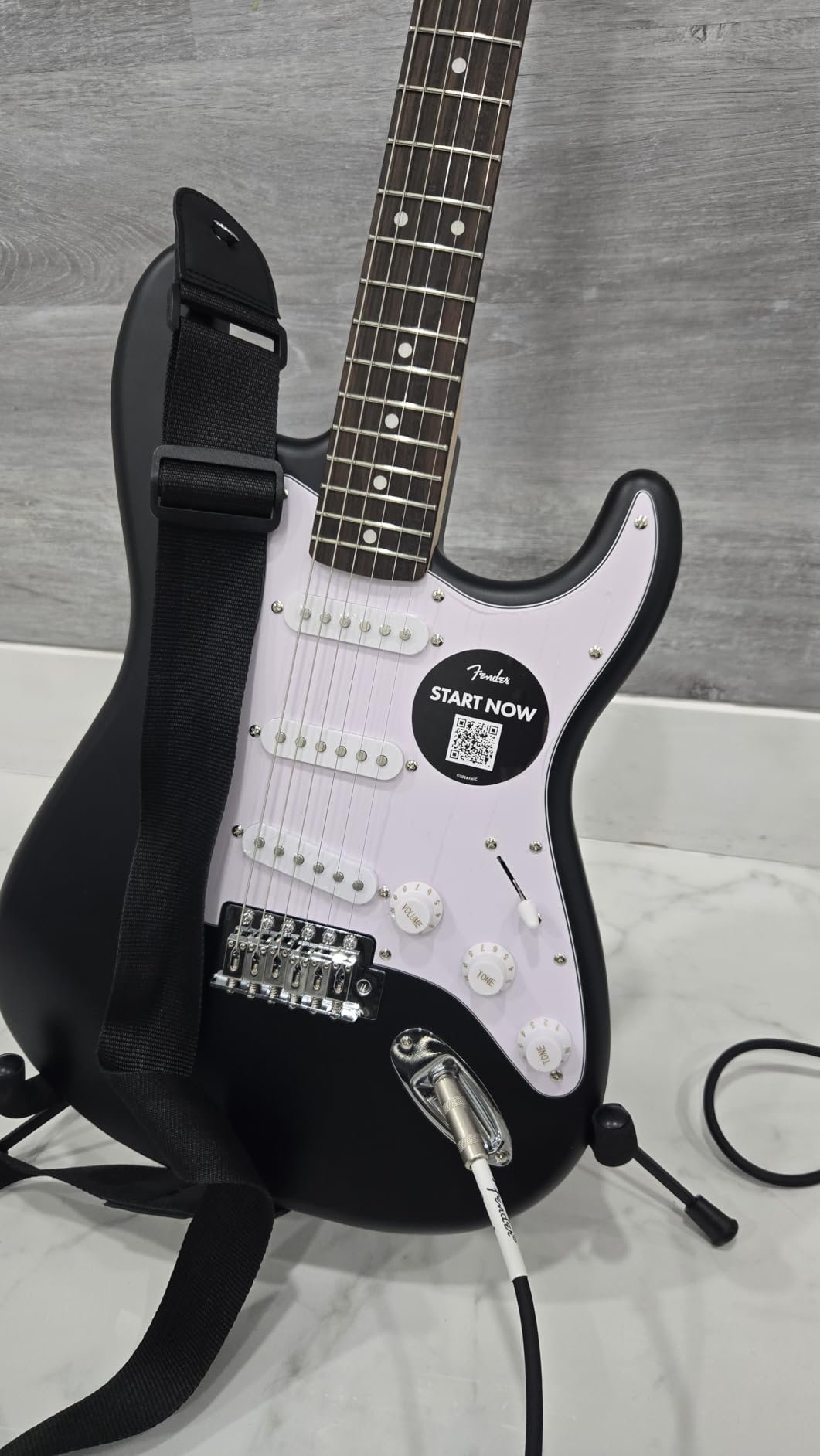
This is the kit I hand to most new students, because everything arrives in one box and works together. Guitar, Frontman 10G amp, padded gig bag, strap, cable, picks, a stand, and a spare set of strings means you unbox and start playing riffs the same afternoon.
The C-shaped maple neck is the real reason it suits easy guitar riffs: it is slim enough that small hands can reach frets 5 through 10 without cramping, which is exactly where seven of the riffs above live. The thin poplar body also keeps the weight down for long sessions.
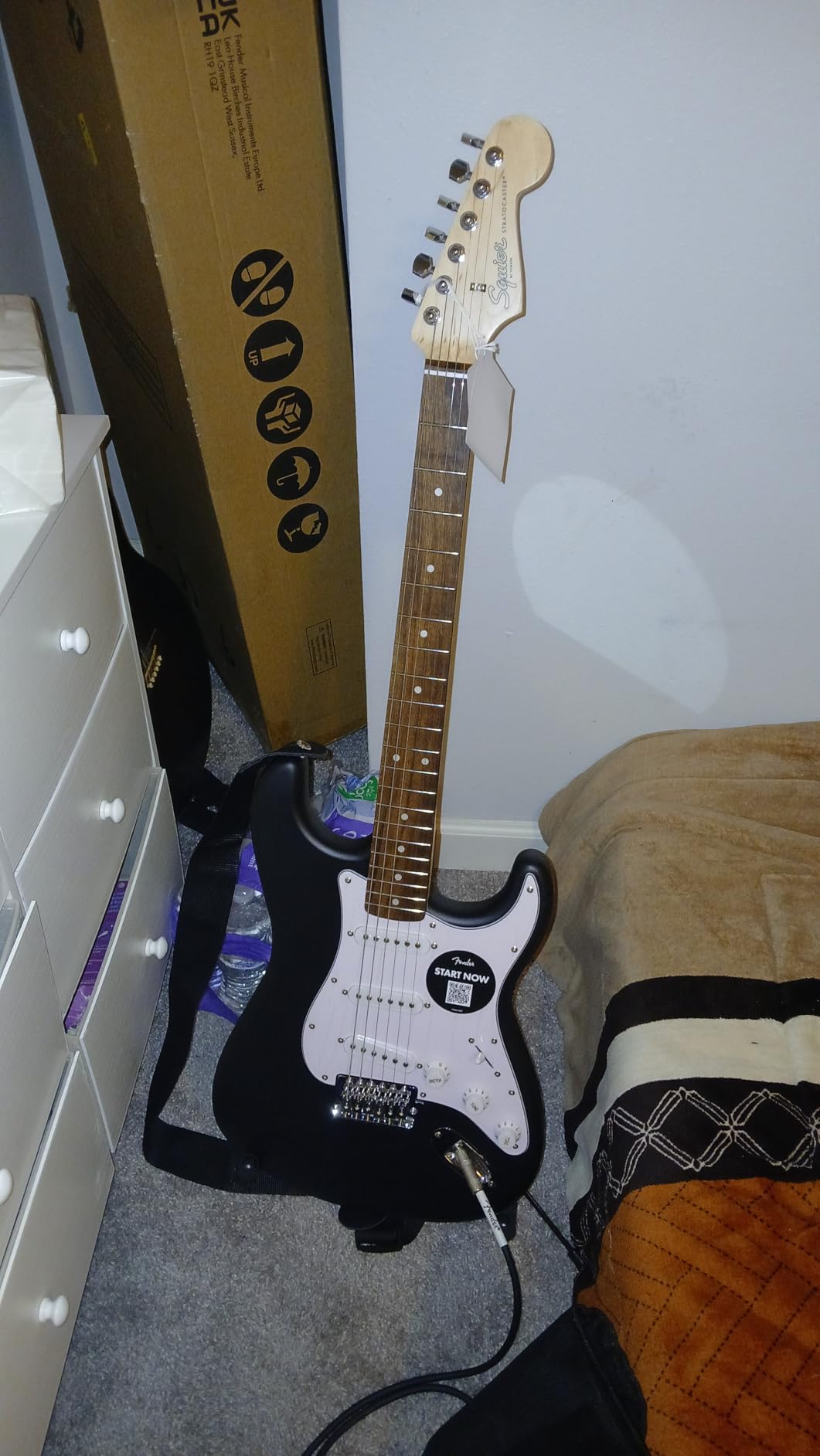
Three single-coil pickups with five-way switching give you classic Strat tones. Position 4, neck plus middle, is the sweet spot for Smoke on the Water, while position 1 on the bridge pickup tightens up Paranoid nicely.
The bundled 30-day Fender Play subscription is a quiet advantage. It walks you through structured lessons that line up with the practice schedule later in this guide, so you are never guessing what to learn next.
Who This Kit Suits Best
Buy this if you are starting from zero and want one purchase to cover guitar, amp, and accessories. It is also the right call for a teenager picking up their first real instrument, or a returning player who sold everything years ago.
It works as a gift too, since the box includes everything a new player needs and the free lessons remove the guesswork of where to begin.
Who Should Look Elsewhere
Skip it if you already own an amp, since you would be paying twice for one. It also is not the right voice for heavy modern metal, where thick humbucker pickups serve high-gain riffs better than bright single-coils.
Players who know they want a fixed bridge and maximum tuning stability may also prefer a hardtail model over the tremolo equipped here.
2. Fender Premium Picks Sampler - Find Your Perfect Pick
What We Like
- Variety pack lets beginners test thicknesses without buying multiple sets
- Premium celluloid material with warm traditional tone
- Trusted Fender quality with 26
- 000+ reviews
- Excellent value for a 12-pack sampler
What We Don't Like
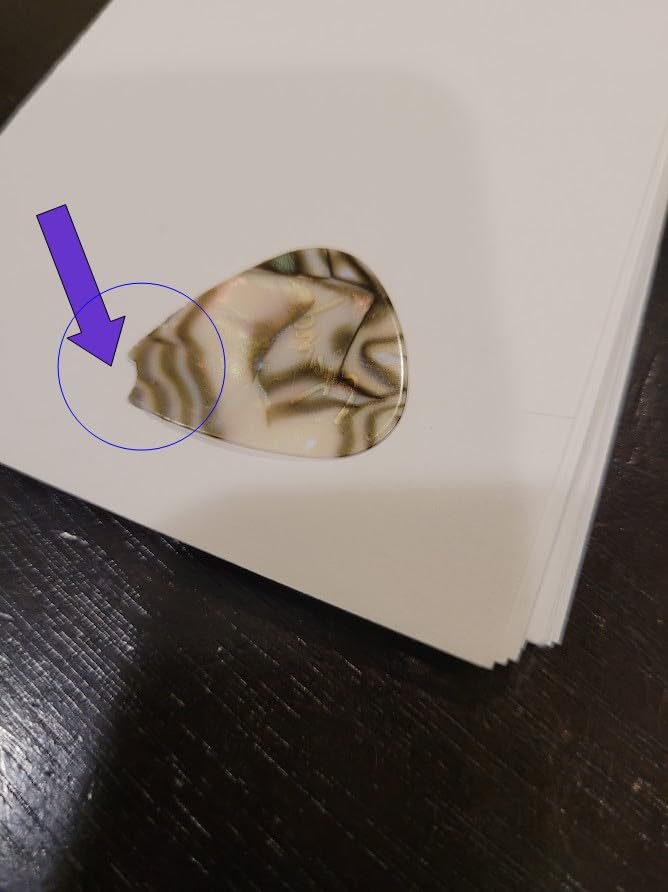
- Occasional quality control issues with a missing pick
- Colors may vary from listing images
- Limited to the single 351 shape
Pick thickness changes how riffs feel more than almost any other cheap variable. This sampler gives you thin, medium, and heavy gauges in one pack, so you can find your preference instead of guessing.
Thin picks around 0.46mm flex into strummed chord riffs like Sweet Home Alabama. Medium, roughly 0.71mm, is the all-rounder I start students on for single-note riffs because it balances flex with control.

Heavy picks near 0.97mm give maximum control for articulate single-note work, which is why most rock players land on medium-heavy for riffing. The celluloid material releases the string smoothly and keeps pick noise low.
The classic 351 shape has a wider body and rounded tip that suits nearly every hand. Buy a multi-pack regardless of brand, because picks disappear into couches at an alarming rate.
Who This Sampler Suits Best
Buy it in your first week of playing, before you develop loyalty to a gauge you never actually chose. With twelve picks for the price of one specialty pack, losing a few to the couch is not a crisis.
It also makes a sensible add-on if you are already ordering a guitar or amp and want to round out the order.
Who Should Look Elsewhere
Pass if you already know your preferred thickness and shape, since this is one shape only. Players who use jazz-style small tips or extra-heavy stubs will want a dedicated pack instead.
If you mainly strum an acoustic, a dedicated thin pack costs less than sampling three gauges you may never use.
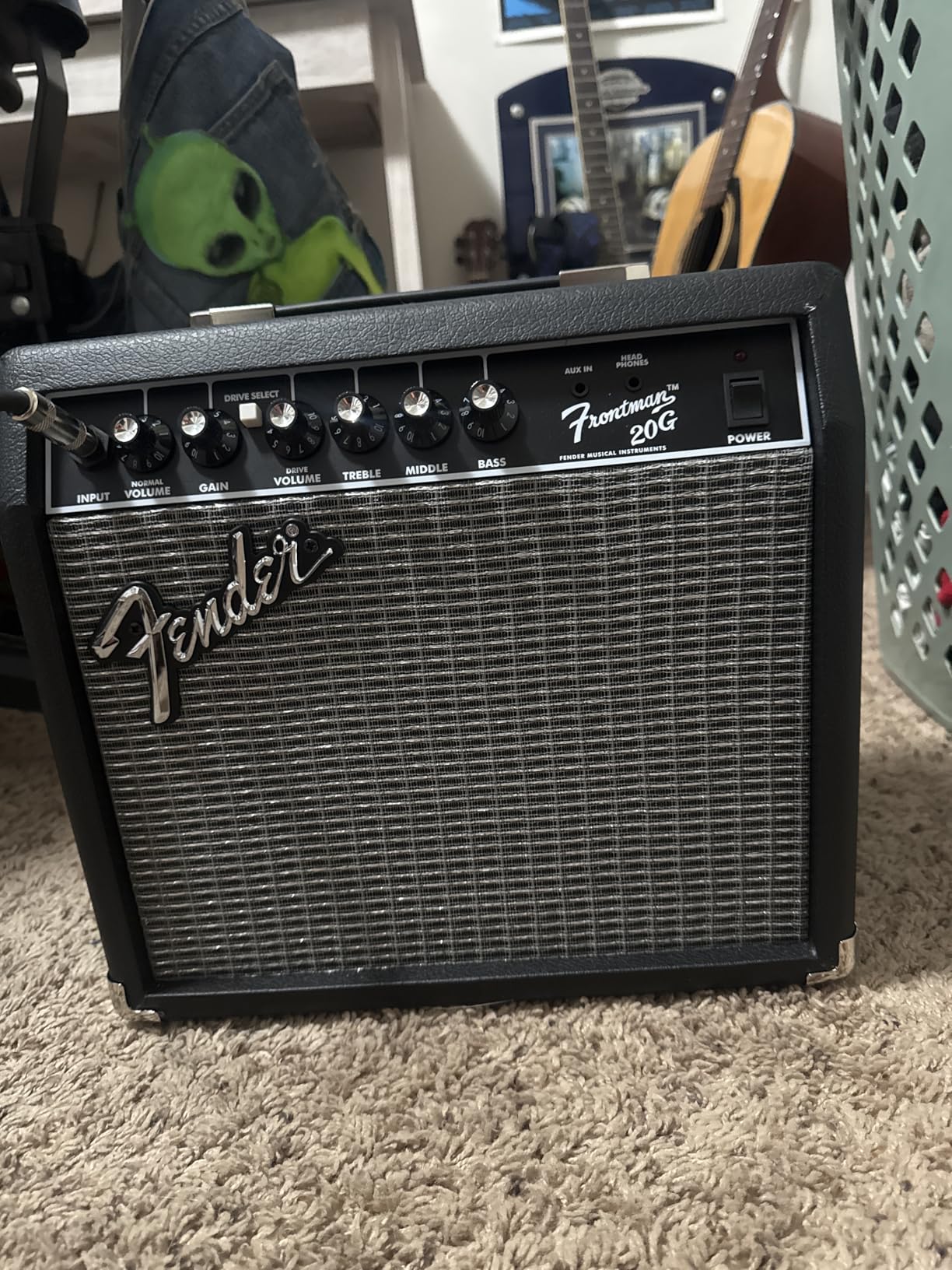
3. Fender Frontman 10G Amplifier - Ideal Practice Amp
Power: 10 watts
Speaker: 6 inch
Controls: Gain, Volume, Treble, Bass
Jacks: Headphone, aux
What We Like
- Perfect volume level for bedroom and apartment practice
- Clean tones rival larger more expensive amps
- Aux input for play-along and headphone jack for silent sessions
- Lightweight and portable with simple controls
What We Don't Like
- Built-in distortion channel lacks quality
- No reverb or built-in effects
- Only suitable for practice rather than band use
For five years running, this is the small amp I put in front of apartment-dwelling students. Ten watts through a 6-inch speaker is loud enough to fill a bedroom and quiet enough that neighbors stay friendly.
The aux input is the feature that actually speeds up learning, because you can pipe a song from your phone and play along. Timing develops far faster against a real drum track than against a metronome alone.
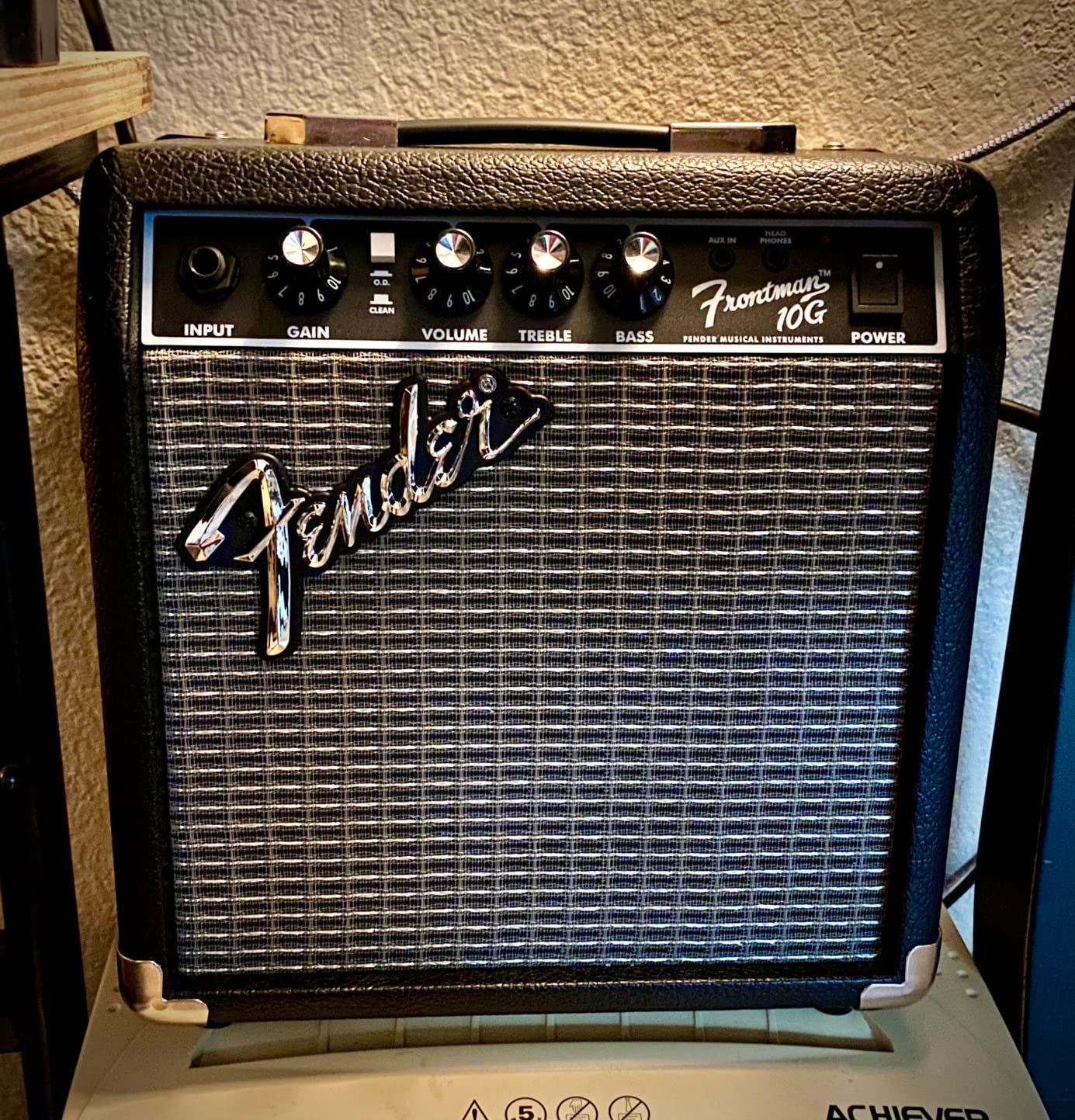
The headphone jack makes silent practice possible at midnight, and the tone holds up surprisingly well through headphones. The closed-back cabinet pushes more bass than you expect from something this small, which helps riffs feel full.
Controls stay simple: gain, volume, treble, and bass. Nudge the gain up for a light overdrive on Satisfaction, then back it off for the clean attack Another One Bites the Dust needs. If clean headroom is your priority, our piece on the best clean guitar amps goes deeper.
Who This Amp Suits Best
Buy it if you practice at home, need headphone compatibility, or want a first amp light enough to carry anywhere. It pairs perfectly with the Squier kit above if you buy the guitar separately.
It is also a smart second amp for experienced players who want a quiet desk setup for late-night riff practice.
Who Should Look Elsewhere
Skip it if you plan to rehearse with a drummer soon, because ten watts will not cut it. The onboard overdrive is also thin for serious metal tones, so players chasing high-gain riffs should budget for a pedal or a bigger amp.
If you want built-in effects to explore, a modeling amp will serve you better than this straightforward control layout.
How to Practice Guitar Riffs Effectively
Looking across hundreds of student progress patterns, the method below is what separates players who improve quickly from those who plateau. It is not talent; it is structure.
The 15-Minute Daily Method
Fifteen minutes every day beats two hours once a week, because muscle memory consolidates through frequency rather than volume. Split the session into three blocks of five minutes.
Warm up with a riff you already know, spend the middle block working a new riff slowly, then finish by playing along with the original recording. That final block is where timing actually develops.
Set a phone timer and respect the limit it sets, even if it interrupts a riff you are finally nailing. Pairing the routine with a lesson from one of the best YouTube guitar lesson channels adds a visual check on your picking hand that text tabs cannot provide.
Common Mistakes to Avoid
Playing too fast too early is the number one error. Speed built on sloppy technique takes weeks to unlearn, so stay at half tempo until you can play a riff cleanly five times in a row.
Chasing notes while ignoring rhythm produces mechanical, lifeless riffs. Count out loud or use a metronome from day one, even when it feels awkward.
Practicing without the recording is the quiet progress killer. Once you know the notes, play along with the track, because the song itself is the best backing track you will ever own.
Progression Timeline
Week one, aim for one complete riff, and Seven Nation Army is the usual suspect. The focus is single notes and steady timing.
Week two moves to two-string work with Smoke on the Water, first as single notes, then as double stops. Weeks three and four add Come As You Are and Day Tripper, where the work is smooth transitions and syncopation.
Weeks five through eight introduce power chord riffs like Back in Black and the remaining songs, building two-hand coordination. For a fuller curriculum beyond riffs, our roundup of the best guitar books for beginners has options with a proven track record.
Frequently Asked Questions
What is the easiest guitar riff to learn first?
Seven Nation Army by The White Stripes is the easiest guitar riff to learn first, using just seven notes on the A string that most beginners master within 30 minutes. Smoke on the Water is a close second because its melody is famous enough that you will hear any mistakes instantly.
What is the forbidden riff on a guitar?
The forbidden riff is Stairway to Heaven by Led Zeppelin, a nickname born from guitar store staff hearing it countless times a day. Many stores jokingly banned it, along with Smoke on the Water and Sweet Child O Mine, and the joke became guitar culture folklore. Nothing actually stops you from learning it.
What are the top 10 guitar riffs?
The most cited top 10 guitar riffs include Smoke on the Water, Sweet Child O Mine, Back in Black, Whole Lotta Love, Satisfaction, Enter Sandman, Smells Like Teen Spirit, Iron Man, Seven Nation Army, and Sweet Home Alabama. Rankings vary by publication, but those ten appear on the majority of all-time lists.
What are 10 easy guitar songs for beginners?
Ten easy guitar songs for beginners are Seven Nation Army, Smoke on the Water, Come As You Are, Another One Bites the Dust, Highway to Hell, Sweet Home Alabama, Brain Stew, Smells Like Teen Spirit, Wish You Were Here, and Knockin on Heavens Door. Our full list of easy guitar songs covers chords and strumming patterns for each.
What is the easiest Led Zeppelin riff?
Whole Lotta Love is generally the easiest Led Zeppelin riff, built around a repeating low E string phrase with a simple rhythm. Communication Breakdown is another approachable option, while Stairway to Heaven is better saved for later because its intro demands fingerpicking coordination.
Should I learn chords or riffs first as a beginner?
Start with riffs because single notes and two-note shapes are physically easier than full chords, and playing recognizable songs keeps motivation high. Riffs also build the finger strength and coordination that make chord changes smoother when you add them a few weeks later.
Can you play electric guitar riffs on acoustic guitar?
Yes, most electric guitar riffs transfer directly to acoustic guitar. Single-note riffs translate with no changes, while power chord riffs need a slightly firmer attack because acoustic strings are thicker and higher tension. The tone differs, but the notes and fingering are identical.
How do you read guitar tabs for riffs?
Read a guitar tab by matching the string name to its open note, from low E as the 6th string through high E as the 1st, then pressing the fret number shown. A 0 means play the string open, and numbers in sequence are played in order. Two numbers stacked or joined mean play both strings together.
Start Playing Today
Learning easy guitar riffs remains the fastest route from wanting to play to actually playing. Within days you will have music people recognize, and that early payoff is what carries you through the harder work ahead.
Start with Seven Nation Army today, and only today. Fifteen minutes, one string, slow and clean beats an hour of rushing through five riffs you half-know.
Every professional guitarist began on riffs exactly like these, lifting phrases off records and repeating them until the notes felt natural. The only difference between them and you right now is hours logged, and those start accumulating at your next practice session.
When these ten feel comfortable, move on to full songs with our guide to easy guitar songs for beginners. Pick up the guitar, work the first tab, and you will be surprising yourself within two weeks.

Charles Eames is a designer, filmmaker, and the Co-Founder of Powers Of 10. Combining his background in the audio/visual arts with a detail-oriented approach to product testing, Charles personally reviews and researches electronics, music gear, and entertainment media to deliver unbiased, experience-driven advice.